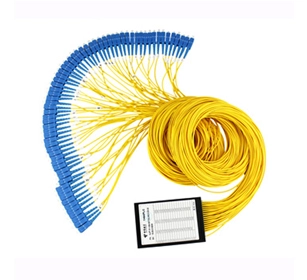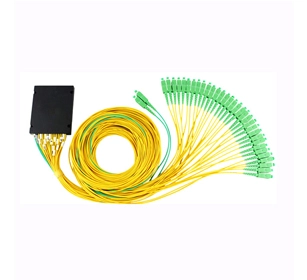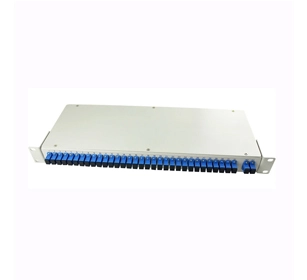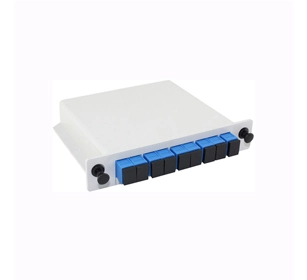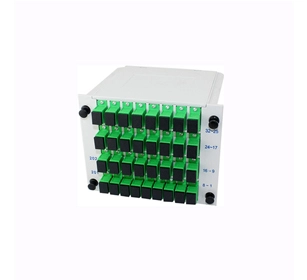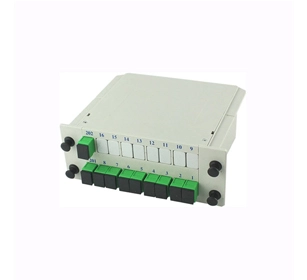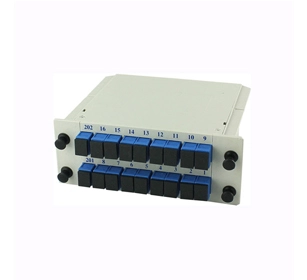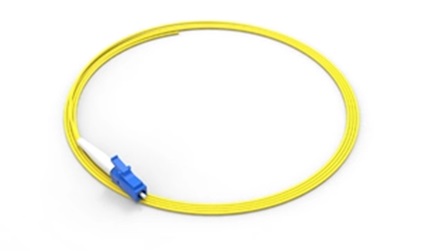



A fiber optic splitter is a passive device that divides a single optical signal into multiple signals, enabling one light source to be shared among many users. It is a component of the EPON network, a passive device that connects the OLT and the ONU, and its function is to distribute downstream data and centralize upstream data.
As a professional fiber optic PLC splitter supplier, OTRANS delivers high-performance optical PLC splitters designed for reliability and scalability. We provide quality solutions tailored for global telecommunications and data networks.
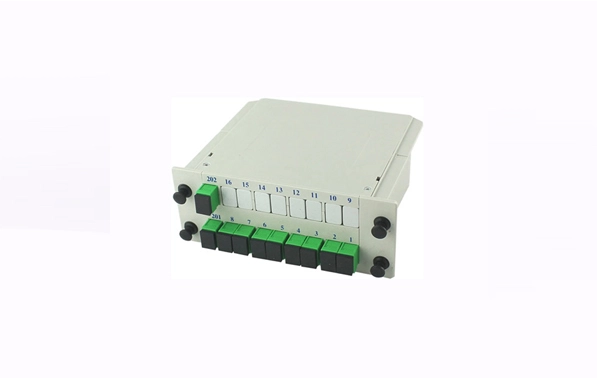
An optical splitter distributes optical signals transmitted in one fiber to multiple fibers. There are a number of different distributions, 1 x 2,1 x N, or 2 x 4, M x N. The general architecture of FTTH is: OLT -- ODN -- ONU, in which the optical splitter is applied in the ODN to realize that multiple end users share a PON interface.
In PON structure, when the distribution of buildings is scattered and irregular, such as the distribution of villas, the distance is far away, and the user density is low, the centralized splitting method can make full use of resources and cover the surrounding area. OTRANS, one of the reliable fiber optic plc splitter manufacturers, ensures optimal performance in such deployments.

Low Insertion Loss: PLC splitters minimize signal degradation, with typical values ranging from 3.3 to 3.9 dB for a 1x2 configuration, ensuring efficient power distribution in PON systems. Competitors like FS.com report maximum allowable losses under 4.0 dB for 1x2 and up to 17.2 dB for 1x32, which is lower than traditional FBT splitters.
Wide Wavelength Range (1260-1650nm): Supports multiple applications including EPON, GPON, and FTTH, allowing compatibility with various fiber optic systems without performance drops across the spectrum.
High Reliability: Operates stably in extreme temperatures from -40°C to 85°C, with uniform splitting and low excess loss (typically 0.5-1.5 dB), making them ideal for harsh environments and long-term deployments.
Compact Design: Features a small form factor, such as mini tube or ABS box types, enabling easy integration into dense network setups like data centers or distribution frames while reducing space requirements.
| Type | Configuration | Applications | Key Features |
| Mini Tube | 1x32 SC-APC | FTTx, PON | Compact, easy installation |
| Bare Type | 1x16 Bare | Indoor splicing | No connectors, flexible |
| ABS Box | 1x8 SC/APC | Distribution boxes | Rugged, protected |
| LGX Type | 2x32 SC-UPC | Rack-mount | Modular, high-density |

 Do you provide customized PLC splitters?
Yes! As a trusted fiber optic PLC splitter factory, OTRANS offers full customization, including:
Specific split ratios (e.g., non-standard 2xN)
Connector types (SC/APC, LC/UPC, etc.)
Packaging (special lengths, colors, ruggedized)
Branding, labeling, and OEM/ODM services
Get a free quote today for tailored solutions that meet your exact network requirements. Contact us
How to choose the right PLC splitter for my network?
Consider these factors:
User Density & Coverage — Use 1x32/1x64 for high-density areas; 1x8/1x16 for scattered villas.
Split Ratio — Match to OLT port capacity and power budget (higher ratio = more loss).
Installation Environment — Indoor: rack mount/LGX; Outdoor: ABS box/ruggedized.
Performance Needs — Check insertion loss, uniformity, and wavelength compatibility with your PON standard (GPON/EPON/XG-PON).
Budget & Scalability — PLC excels for future-proof high-split networks.
Contact OTRANS for expert advice—we'll recommend based on your topology.
Are PLC splitters suitable for outdoor use?
Yes, but it depends on the packaging:
ABS Box or ruggedized/mini tube types with IP65+ sealing are suitable for outdoor cabinets, aerial/underground closures, or wall-mounted enclosures.
Bare or mini tube without extra protection are better for indoor/controlled environments.
PLC chips handle -40°C to +85°C, humidity, and vibration well (Telcordia GR-1221 compliant).
OTRANS provides outdoor-rated options for harsh OSP deployments.
What wavelength range do PLC splitters support?
PLC splitters operate across a wide wavelength range of 1260–1650 nm, covering:
1310 nm (upstream in GPON/EPON)
1490 nm (downstream in GPON)
1550 nm (RF video overlay or CATV)
Compatibility with XG-PON/XGS-PON (up to 10G+ speeds)
This broadband support makes them versatile for modern PON systems, unlike narrower-band alternatives.
What is the typical insertion loss for different split ratios?
Insertion loss measures total signal attenuation (including splitting + excess loss). Values comply with Telcordia GR-1209 standards and typical manufacturer specs:
| Split Ratio | Theoretical Loss (dB) | Typical Insertion Loss (dB, max) | Notes |
| 1x2 | 3.01 | 3.3–4.0 | Very low excess loss |
| 1x4 | 6.02 | 6.8–7.4 | Uniform across ports |
| 1x8 | 9.03 | 10.2–10.5 | Common in FTTH |
| 1x16 | 12.04 | 13.3–13.7 | Balanced performance |
| 1x32 | 15.05 | 16.5–17.2 | Standard for GPON |
| 1x64 | 18.06 | 19.5–20.5 | High-density use |
What is the difference between PLC splitters and FBT splitters?
PLC (Planar Lightwave Circuit) and FBT (Fused Biconical Taper) are the two main optical splitter technologies, with key differences:
Uniformity / Signal Distribution — PLC offers excellent uniformity (even power split across all ports); FBT can have uneven loss, especially at higher ratios.
Wavelength Range — PLC supports broad 1260–1650nm (compatible with GPON, EPON, XG-PON, CATV); FBT is typically limited to specific windows (e.g., 1310/1550nm) with higher wavelength dependency.
Insertion Loss — PLC has lower, more consistent loss (especially for >1:8 splits); FBT loss increases significantly at higher ratios.
Temperature Stability — PLC excels in harsh conditions (-40°C to +85°C); FBT is more sensitive (often -5°C to +75°C).
Cost — FBT is cheaper for low splits (1x2/1x4); PLC becomes more cost-effective for high splits (1x16+) due to better performance and scalability.
Size & Reliability — PLC is compact and more reliable long-term; FBT can be bulkier for cascaded high splits.
PLC is preferred for modern FTTH/PON networks; FBT suits budget or low-split applications.

 English