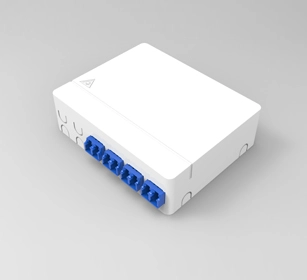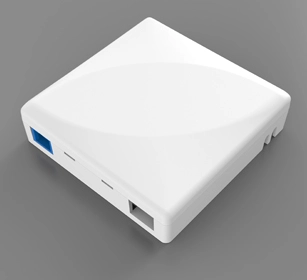


Optical fiber desktop box design, should consider the following aspects:
1. Easy to install and disassemble;
2. With protective door, dustproof;
3. With identification for easy identification;
4. Suitable for multi-class modules and multimedia interfaces;
5. Using high-quality plastic PC/ABS, anti-collision, flame retardant, impact resistance;
6. Beautiful and versatile.
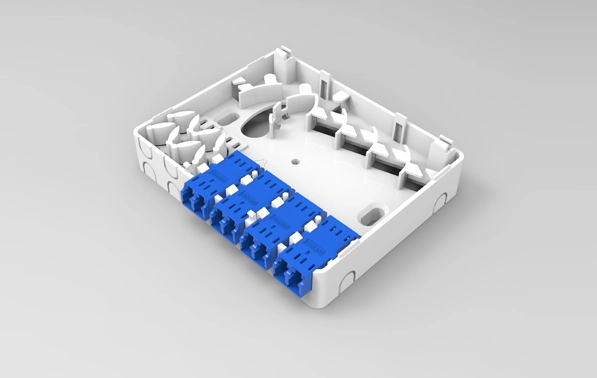
The optical fiber desktop box, also known as an indoor optical outlet, is mainly used in homes or work areas to complete the access and port output of dual-core optical fibers, fully meet the requirements of the bending radius of the optical fiber, and protect the incoming and outgoing optical fibers to provide secure protection for the fiber core. The appropriate radius of curvature allows for the inventory of a small amount of redundant fiber for FTTD (fiber to desktop) system applications.
In wiring systems, while the fiber outlet box is not the main component affecting performance, it is one of the few products exposed on the surface in the entire cabling system. This makes it an essential part of the fiber optic outlet box market for both commercial and residential use.

Easy installation/dismantling with snap-on covers.
Dustproof protective door/shutter.
Clear labeling/identification ports.
Compatible with SC/LC adapters and multimedia modules.
High-impact PC/ABS material: flame-retardant, anti-collision, durable.
Aesthetic design for visible indoor placement.
Bend radius protection for safe fiber management.
Supports redundant fiber storage for maintenance.
| Feature | Specification/Details |
| Material | High-quality PC/ABS (flame-retardant, impact-resistant) |
| Ports/Cores | 2-core or 4-core (SC flanges/fast connectors) |
| Installation | Wall-mounted, surface or flush |
| Protection | Dustproof door, bend radius ≥30mm |
| Dimensions (approx.) | Compact (e.g., 86x86mm standard electrical size) |
| Compatibility | FTTH/FTTD, GPON/EPON, multimedia interfaces |
| Environmental | Indoor use, -20°C to +60°C |

 What is a fiber optic outlet box?
A fiber optic outlet box, also known as an indoor optical outlet, optical telecommunication outlet, fiber wall outlet, or fiber faceplate, is a compact, wall-mounted (or desktop) enclosure used as the final termination point in FTTH (Fiber to the Home) or FTTD (Fiber to the Desktop) networks. It securely terminates incoming fiber drop cables, houses adapters (e.g., SC or LC), protects splices or pigtails, manages fiber bend radius to prevent signal loss, and provides dustproof shielding while allowing easy patching to end-user devices like ONTs, routers, or switches.
Unlike larger distribution boxes, it's designed for visible indoor use in homes, offices, or apartments, blending aesthetics with functionality. OTRANS's models (e.g., BIA-002A 2-core and BIA-004A 4-core) are made from durable, flame-retardant PC/ABS material for reliable protection and easy installation.
How does a fiber optic outlet box protect fiber in FTTH?
In FTTH networks, the fiber optic outlet box provides essential end-point protection:
Bend Radius Management: Ensures fiber maintains a safe minimum bend radius (typically ≥30mm for patch cords/drop cables) using internal routing guides and slack storage, preventing macro-bending losses and micro-cracks that degrade signal quality.
Physical Protection: Shields splices, pigtails, and connectors from dust, accidental impacts, and tampering with a protective door/cover.
Environmental Durability: Made from high-impact, flame-retardant PC/ABS material, it withstands indoor conditions (-20°C to +60°C) and prevents fiber stress during installation or maintenance.
Cable Management: Allows safe storage of small redundant fiber lengths and clear labeling for quick identification.
This protection is critical at the user end, where the box safeguards the final drop cable connection from the distribution point to the ONT/router, ensuring long-term reliability in residential or commercial FTTH deployments.
Is a fiber optic outlet box suitable for desktop installation?
Yes, many fiber optic outlet boxes are suitable for desktop (or under-desk) installation in FTTD (Fiber to the Desktop) setups, in addition to traditional wall mounting.
Wall-Mount: Standard for homes/offices—surface or flush-mounted near power outlets for clean aesthetics.
Desktop/Under-Desk: Models with compact designs and optional mounting brackets can sit on or under desks, ideal for enterprise environments, workstations, or temporary setups where wall access is limited.
Key Features for Desktop Use: Easy snap-on covers, low-profile design, and compatibility with multimedia interfaces make them versatile.
OTRANS's BIA-002A and BIA-004A boxes support flexible installation (wall or desktop) with straightforward mounting holes and protective features. Contact us for recommendations based on your space.
What is the difference between a fiber optic outlet box and a fiber distribution box?
While both manage fiber optics, they serve different roles in the network:
Fiber Optic Outlet Box (also called optical telecommunication outlet or wall outlet): Compact, indoor end-user device for final termination at the home/office. It protects and connects the last drop cable to the ONT/router, focuses on aesthetics, dust protection, and bend radius for 1–4 users. Typically wall-mounted or desktop, small size (e.g., 86x86mm standard).
Fiber Distribution Box (FDB or fiber distribution hub): Larger, often outdoor or building-level enclosure that splits/distributes signals from feeder cables to multiple drop cables (e.g., 8–32 ports). It handles splicing, splitting (via PLC splitters), and branching for neighborhoods or floors, with higher capacity and IP65+ weatherproofing.
In short: Outlet box = user-end termination point; Distribution box = intermediate splitting/distribution hub. OTRANS offers both—outlet boxes for FTTH endpoints and distribution solutions for upstream.

 English